Daniel carries the Sea of Flames out of Paris
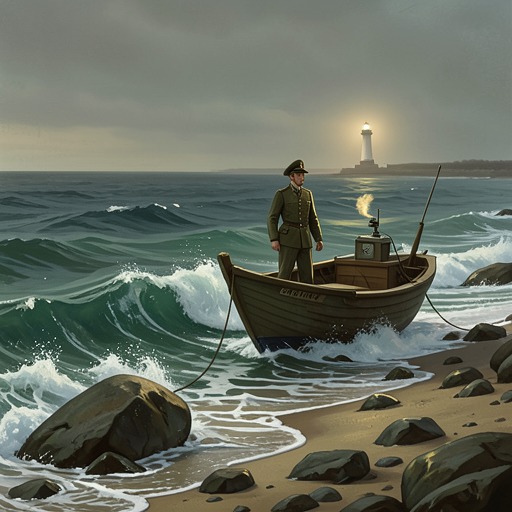
All the Light We Cannot SeeDaniel LeBlanc’s journey out of Paris carries a gemstone entrusted to him by the Paris Natural History Museum, but not the certainty that it is the Sea of Flames. The museum sends the stone along one of several routes among three replicas, deliberately keeping each courier ignorant of whether he carries the original. Hidden in Daniel’s tool case as his daughter sleeps nearby, it becomes both a protected object and an unanswered question: he must treat it as real without knowing whether it is.
Evacuation and the Museum’s Plan
As war approaches, the Paris Natural History Museum moves its collections out of danger. Daniel, its principal locksmith, works late to secure crates, padlock transports, and protect the manifests. The undertaking encompasses objects of very different kinds and scales, from fossils and ancient manuscripts to jade, Indian cavansite, Colorado rhodochrosite, pearls, gold nuggets, and a sapphire as large as a mouse. Amid those precautions, Marie-Laure wonders whether the Sea of Flames is also among the things being safeguarded.
The museum’s plan distributes uncertainty as deliberately as it distributes the stones. There are four in all: the genuine diamond and three decoys. One remains at the museum; the others travel in three different directions. A young geologist takes one south, the chief of security carries another north, and Daniel carries the third away from Paris. The director instructs the couriers to behave as though each holds the real diamond. Because none is told which stone is genuine, the plan protects the original not only by concealment but by making every route appear equally important.
The Stone in the Tool Case
On a field west of Versailles, Marie-Laure falls asleep while Daniel sits with her. When his cigarette is gone, he eases her feet to the ground, covers her with her coat, and opens his rucksack. The case holds woodworking tools, many inherited from his grandfather: tiny saws, tacks, gouges, carving chisels, and fine-gritted sandpapers. Beneath the case’s lining, he has concealed a heavy linen bag tied with a drawstring. He has restrained himself from checking it all day; now, with his daughter asleep, he finally opens it.
The stone in his palm is about the size of a chestnut. In the dim light it glows blue, and it feels strangely cold. The director’s instruction—that each courier must act as if he carries the real thing—collides with Daniel’s private reasoning. He tells himself the stone must be false: surely the director would not entrust a tradesman with a diamond of 133 carats and let him leave Paris with it. Yet looking at the gem, he cannot quiet the possibility that it is genuine. He reties the bag, returns it to the rucksack, and feels its tiny weight as though it has become a knot inside his own mind.
The scene makes the stone’s material presence inseparable from the uncertainty surrounding it. Daniel can touch and weigh what he carries, but neither sensation nor the museum’s precautions tells him whether it is the original. The hidden bag turns an ordinary tool case into a bearer of extraordinary risk; the old tools around it belong to Daniel’s practical craft, while the concealed gem places that craft in the service of an institutional secret. His silence about the stone is not proof that he knows what it is: the plan depends on his not knowing.
Departure into Danger
Hours later, Daniel wakes to an airplane crossing the stars. Its passage makes a soft tearing sound; a moment later the ground shakes. Beyond the trees, the sky turns red, and he sees that the first plane is not alone: a dozen aircraft swoop in different directions. The contrast between the quiet field, Marie-Laure’s measured sleeping breath, and the sudden violence overhead places the museum’s careful system of locks, keys, and separate routes inside a war that cannot be secured by those measures. Daniel has carried the concealed stone away from Paris, but the journey offers no confirmation that it—and the people around it—are safe.
The museum’s later account of the replicas preserves that uncertainty rather than resolving Daniel’s doubt. In the two months before the invasion of France, Dupont made three replicas using a casting; he never saw the genuine diamond. Reinhold von Rumpel believes Dupont’s account. The distinction is crucial: the copies were made without the original being used as a model, and their maker could not identify which stone Daniel or the other couriers carried. The objects’ resemblance and the couriers’ separate journeys do not, by themselves, establish the identity of Daniel’s stone.
Arrest and the Unsettled Fate of the Stone
Daniel’s journey is followed by arrest outside Vitré, hours from Paris. Plainclothes policemen pull him off a train while other passengers watch, then question him first in a van and later in a cold mezzanine office. They display his notebook and tool case, count seven skeleton keys on his ring, and demand to know what the keys and his tiny files and saws are for. Daniel answers that he is making a model for his daughter and that the keys are for the museum where he works. The interrogation thus turns the same professional objects that made him useful in the collection’s evacuation into grounds for suspicion.
The German questioning the next morning is terse, and the officials appear to accuse Daniel of plotting to destroy the Château de Saint-Malo, though the reason is unclear. They deny him paper, linens, and access to a telephone, and they have photographs of him. Two days after his arrest he is taken to a holding pen outside Strasbourg, where he watches uniformed schoolgirls pass beyond the fence and shares the enclosure with roughly thirty other detainees. The evidence establishes Daniel’s detention and the authorities’ confusion about his alleged purpose; it does not establish that they have discovered the stone or that the stone caused his arrest.
The later count of four stones—one in the museum basement safe and three still to be found—keeps the question of the Sea of Flames open. Daniel’s part in the evacuation is therefore defined by a double uncertainty: he carries a gem the museum has placed on a dangerous route, yet he cannot know whether it is the original; and the record of his arrest does not reveal what became of it. His journey protects the possibility of the diamond’s survival while making its location, and his own fate, harder to trace.